Vaccination Programme.
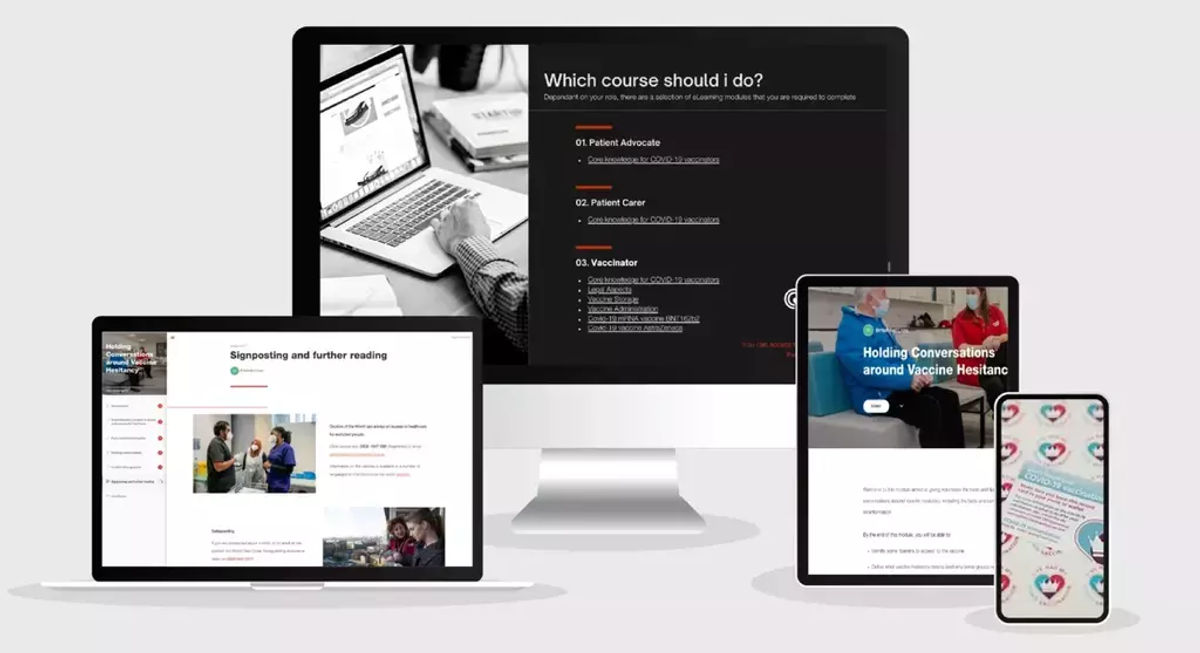
Rapidly designed and deployed a centralised blended learning programme and Moodle platform to coordinate and upskill personnel from the British Red Cross, St John Ambulance, and the NHS during the initial phase of the COVID-19 pandemic, providing a single source of truth under emergency conditions.
organisations served
from one platform

The Challenge.
The COVID-19 pandemic created an urgent and unprecedented need for rapid, widespread knowledge dissemination and skills development across multiple critical organisations. A decentralised training landscape hindered coordination, created inconsistent messaging, and slowed the ability to upskill and deploy personnel at the pace the crisis demanded. A single, reliable, and immediately accessible learning platform was essential.
Speed and Scale
Training needed to reach a large, dispersed workforce across three major organisations within days, not months. The design and deployment timeline was driven by the operational urgency of the pandemic response.
Consistency Under Pressure
Conflicting information and decentralised resources created confusion and risk. A single source of truth was critical to ensuring all trained personnel received accurate, consistent guidance.

Methodology.
A rapid blended learning deployment model was adopted, combining a centralised Moodle LMS with modular eLearning content and live virtual ILT sessions, designed and deployed in close collaboration with stakeholders from all three partner organisations.
- Step 01
Centralised Platform
Moodle was deployed as the single source of truth for all COVID-19 training and resources, providing 24/7 accessibility to front-line staff, volunteers, and healthcare professionals.
- Step 02
Needs Analysis Under Crisis
Stakeholder consultations across all three organisations informed the development of modular eLearning and vILT content, ensuring training addressed specific, real-time operational needs.
- Step 03
Microlearning and Scenario Design
Modules incorporated microlearning principles and scenario-based knowledge checks, maximising retention and practical readiness in a high-pressure, time-scarce environment.
- Step 04
Virtual ILT
Live Zoom sessions supplemented self-paced content, providing opportunities for practical application, real-time Q&A, and direct response to evolving guidance from partner organisations.

The Approach.
Agility and stakeholder collaboration were the defining characteristics of this project. The design and delivery team had to build, test, and iterate at a pace that matched the rapidly changing demands of the pandemic response, maintaining quality without the luxury of standard development timelines.
- Rapid Deployment Protocol
Content was developed iteratively, published to Moodle as it was completed, and updated in real time as guidance from partner organisations evolved, ensuring the platform always reflected the current operational reality.
- Cross-Organisation Alignment
Regular communication and shared governance across the British Red Cross, St John Ambulance, and the NHS ensured a coordinated, consistent approach to training messaging and delivery.
- Data-Driven Adaptation
LMS analytics and vILT feedback loops provided real-time performance data, enabling rapid content adjustments and informing prioritisation decisions under extreme time pressure.
- Accessibility at Scale
The 24/7 availability of the Moodle platform, accessible on any device, was critical for personnel working unpredictable hours across multiple locations and settings.

The Impact.
The first cohort was trained and ready for deployment within 72 hours of brief. Across all three partner organisations, the module completion rate reached 89%, and 96% of personnel reported feeling prepared for their deployment role following training. The centralised platform eliminated the inconsistent messaging that had created operational risk in the decentralised pre-platform period.