Food Safety Level 3.
Redesigned a purely in-person Food Safety Level 3 certification programme into a blended learning solution, achieving a 33% reduction in logistical costs while improving knowledge retention, scheduling flexibility, and learner engagement for 120 employees annually.
costs

The Challenge.
The existing Food Safety Level 3 certification programme relied entirely on in-person classroom delivery, generating high logistical costs from employee travel and accommodation, limiting scheduling flexibility, and delivering suboptimal knowledge retention through passive lecture formats. For a programme reaching 120 employees annually, the cumulative inefficiency represented a significant and addressable cost and quality challenge.
Logistical Cost and Inflexibility
Substantial travel and accommodation costs, combined with the operational disruption of pulling employees off-site for extended classroom sessions, made the existing model financially and practically unsustainable.
Retention and Engagement
Passive, lecture-based delivery did not support long-term knowledge retention for critical food safety practices. The format needed to be redesigned around active, applied learning.

Methodology.
A blended learning solution was designed to retain the practical and collaborative benefits of in-person delivery while shifting foundational knowledge acquisition to an engaging, flexible online format, reducing cost and improving both access and retention.
- Step 01
Self-Paced Online Modules
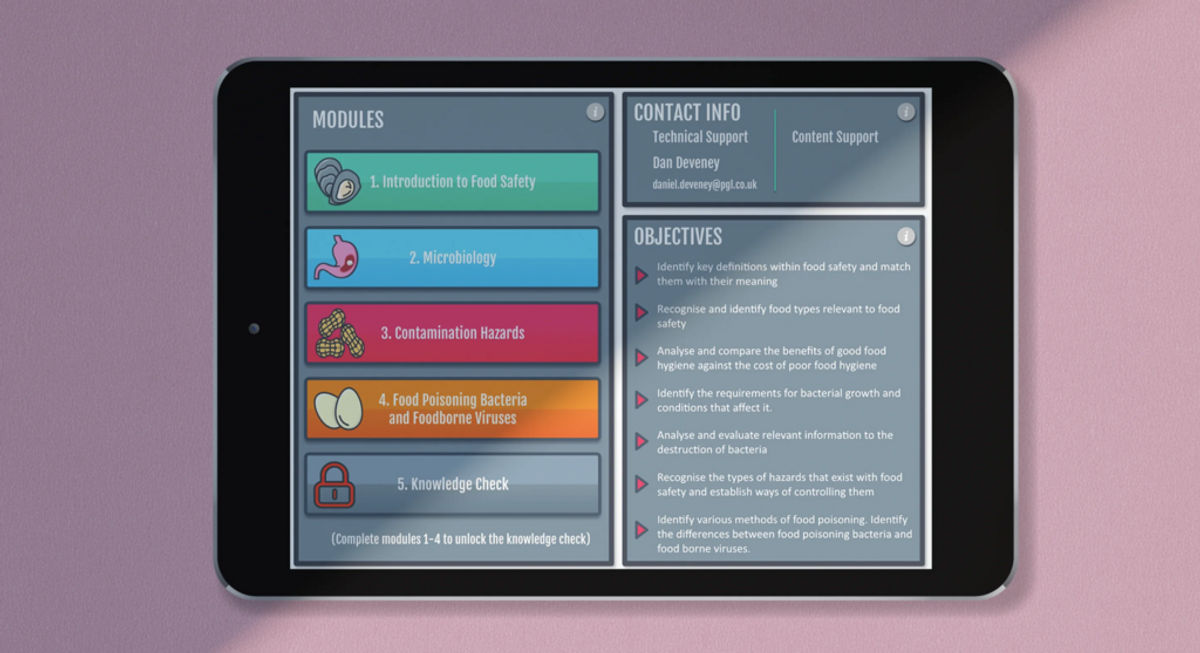
Interactive eLearning modules were developed in Articulate Storyline, incorporating video, simulations, and knowledge checks to actively involve learners and support self-directed progression.
- Step 02
Focused In-Person Session
A shorter, redesigned in-person component concentrated exclusively on practical application, hands-on activities, and scenario-based exercises that could only be delivered effectively face to face.
- Step 03
LMS Deployment
Moodle provided the central platform for hosting modules, tracking learner progress, managing enrolment, and generating completion data for compliance reporting.
- Step 04
Pilot and Iteration
A structured pilot was conducted, with learner feedback actively gathered and incorporated to refine both the online modules and the redesigned in-person session before full rollout.

The Approach.
Close collaboration with food safety subject matter experts ensured the accuracy, legal compliance, and practical relevance of all content, while a data-driven approach to tracking and improvement enabled ongoing programme optimisation beyond initial launch.
- SME Collaboration
Food safety experts were embedded throughout content development to ensure regulatory accuracy, legislative currency, and practical applicability across all modules and scenarios.
- Data Analytics Integration
LMS data analytics were used to monitor completion rates, test scores, and areas of learner difficulty, providing a continuous improvement feedback loop from launch onwards.
- Cost Reduction Modelling
The blended model was specifically designed to eliminate the travel and accommodation requirement for the knowledge-transfer phase, with the 33% logistical cost reduction as a primary design success criterion.
- Learner Feedback Loop
Structured feedback from the pilot cohort was treated as design input, not post-launch review, enabling informed refinements before the programme reached the full 120-employee annual audience.

The Impact.
Logistical costs fell by 25% and each employee saved 22 hours previously spent on travel and extended classroom time. The Level 3 certification pass rate rose from 76% under the previous model to 91% with the blended approach, reflecting genuine gains in knowledge retention. The programme achieved a learner satisfaction score of 4.5 out of 5.