Humankind
EducatorHub.
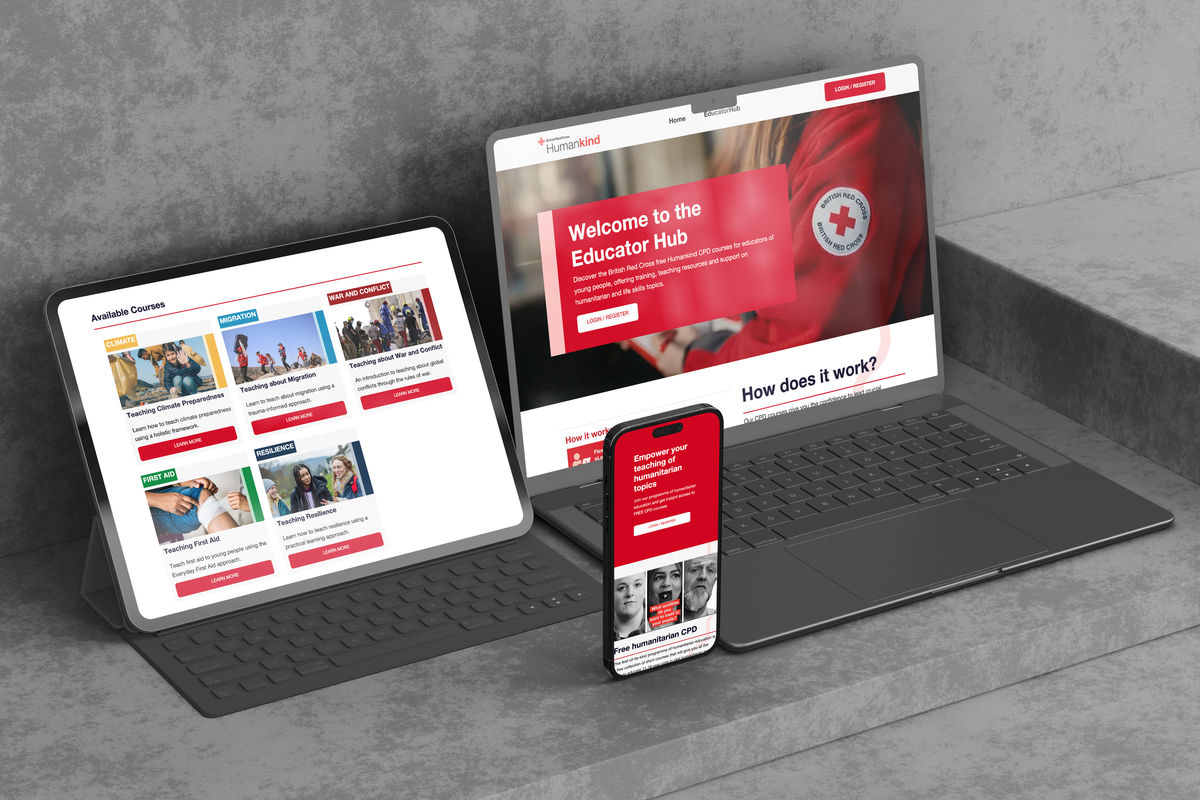
Designing & developing a bespoke Moodle LMS from the ground up to scale humanitarian education across UK secondary schools, delivering measurable reach without a proportional increase in staffing costs.
through the platform

The Challenge.
UK educators recognised the importance of humanitarian issues but lacked the confidence, resources, and pedagogical framework to teach sensitive topics effectively. The British Red Cross also needed to scale its educational reach beyond costly face-to-face workshops, while maintaining the emotional intelligence and quality standards the subject matter demands.
Confidence Gap
Educators needed curated resources and a clear framework, not just content. Existing provision could not address the nuanced, emotionally complex nature of humanitarian subjects.
Scale vs. Cost
Reaching thousands of educators simultaneously through traditional methods was neither sustainable nor cost-effective. A digital-first model was essential.

Methodology.
A product-led approach was adopted, treating the platform as a living digital product rather than a one-off project. Design decisions were anchored in educator UX, content design methodology, and long-term operational sustainability.
- Step 01
System Architecture
Designed a blended learning framework supporting self-paced digital modules alongside downloadable classroom resources, built for scalability from day one.
- Step 02
Platform Development
Served as lead developer for the Moodle environment, delivering a custom homepage and seamless user journey (UX) from first click to course completion.
- Step 03
Cross-Functional Collaboration
Worked within a product team alongside Product Managers, Content Designers, and Marketing, ensuring the technology served pedagogical goals and brand standards.
- Step 04
Internal Consultancy
Established the systems, documentation, and processes for a smooth operational handover, ensuring long-term platform viability without developer dependency.

The Approach.
Rather than adapting an off-the-shelf solution, the platform was engineered to fit the specific demands of humanitarian education: accessible, emotionally considered, and built to last. The product mindset kept stakeholder collaboration central throughout.
- Lean Architecture
Building bespoke avoided the bloat of off-the-shelf tools, producing a faster, more intuitive experience for time-pressured educators.
- Educator-First UX
Every design decision was stress-tested against the needs of busy secondary school professionals, reducing friction from discovery to resource download.
- Handover Design
System design was treated as dual-output: the platform itself, and the operational playbook enabling the community education team to manage it post-launch.
- Agile Delivery
Sprint-based planning via Jira and Confluence kept the product team aligned and responsive to evolving requirements throughout the build.

The Impact.
The platform redefined the British Red Cross's educational outreach model. Over 4500 students were reached and 1500 teachers enrolled, with 78% reporting increased confidence teaching humanitarian topics. The digital-first model delivered a 62% cost saving against equivalent face-to-face provision, while an 84% module completion rate evidenced strong learner activation and sustained engagement.
Indirect reach through train the trainer model.
Trained across the UK through the Humankind digital platform.
Average educator confidence rating after completing the learning.
The digital-first model delivered significant cost savings.